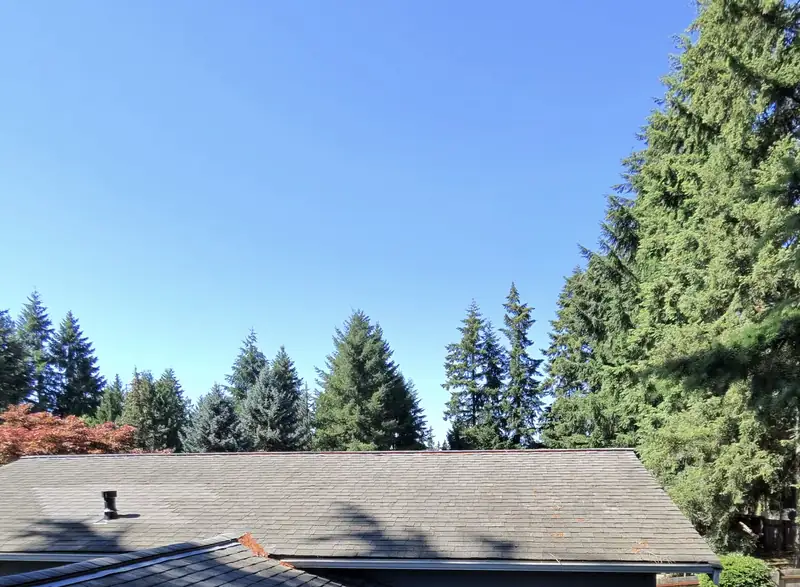

How long does a roof last depends on the material: the USDA Forest Service lists 10 to 15 years for 3-tab organic asphalt shingles, 15 to 25 years for 3-tab fiberglass, 20 to 30 years for architectural shingles and 30 to 50 years for painted standing seam steel. Fenix Roof Service, family-owned since 2016, inspects and replaces roofs in Seattle, Kent, Tacoma, Renton, Auburn and Federal Way, WA.
Roof lifespan by material, according to the USDA Forest Service
Roof lifespan by material, as used in this Washington roofing guide, comes from one official source: the USDA Forest Service Overview of Roofing Materials for Forest Service Facilities. The agency wrote the overview for its own facilities, so treat the ranges as a general national reference, not a rule for Washington homes.
Each range below is copied from that overview. The comments column shows the only extra detail the source gives for each material, such as climate for organic shingles or maintenance for cedar shake.
| Roofing material | Lifespan (USDA Forest Service) | Detail the source adds |
|---|---|---|
| Asphalt, 3-tab organic shingle | 10 to 15 years | Depending on climate |
| Asphalt 3-tab fiberglass shingle | 15 to 25 years | No extra detail given |
| Architectural asphalt shingle | 20- to 30-year lifespan | A heavy, laminated shingle |
| Standing seam steel, painted | 30 to 50 years | Factory-applied coatings extend the lifespan |
| Cedar shake | Up to 30 years | With maintenance |
How long asphalt shingle roofs last: 3-tab vs. architectural
Asphalt shingle roof lifespan for Washington homeowners depends on the type of shingle, and the USDA Forest Service overview separates three kinds of asphalt roof shingles. Knowing which one is on your house matters more than the word "asphalt" alone.
3-tab organic shingles have the shortest range in the overview, 10 to 15 years, and the source adds that the figure depends on climate. The overview does not say how much each climate shifts it, so read the range as approximate.
3-tab fiberglass shingles are listed at 15 to 25 years. Architectural asphalt shingles, which the overview describes as "a heavy, laminated shingle," are listed with a 20- to 30-year lifespan.
How long metal and cedar shake roofs last
Metal roof lifespan in the USDA Forest Service overview is given for one specific product: painted standing seam steel. The source says "factory-applied coatings extend the lifespan of these roofs to 30 to 50 years." The overview credits the coating, so the range should not be applied to every kind of metal roof.
Cedar shake has only an upper figure in the overview. The source says that "with maintenance, the roof can last up to 30 years." No lower figure is given, and the 30 years is tied to maintenance, so an unmaintained shake roof should not be expected to reach it.
Why roof age is only a starting point: inspection and upkeep
Roof age alone does not tell a homeowner how much life is left, and the USDA Forest Service overview makes a related point briefly: "Periodic inspection can save money." An inspection can help spot problems earlier, but it cannot promise that a problem will still be small when found.
Roof moss needs both sides of the story. Oregon State University Extension notes in How to control roof moss and prevent long-term damage that "the moss itself doesn’t directly damage roof materials." The same article goes on to warn that moss can lift shingles and let water get underneath them, which is where the longer-term harm can come from.
Read together, the two points mean moss is worth watching even though the plant does not attack the shingle itself. Read the full OSU Extension article before deciding what to do about moss on your roof.
Repair or replace a roof: a decision checklist
Roof repair-or-replace decisions get easier when a homeowner lines up a few facts about the roof before talking price. The checklist below is general guidance, not a rule; any of these points can be outweighed by what an inspection actually finds.
- Age vs. range: where does your roof's age sit in the material's range in the table above?
- Spread of damage: is the problem one spot (a vent, a boot pipe, a section of flashing, a few shingles) or showing up across several slopes?
- Repeat leaks: have leaks returned, or appeared in new places, after earlier fixes?
- Decking: did the inspection find soft or worn decking, and in how many places?
- Maintenance history: for cedar shake especially, the Forest Service range assumes maintenance; has the roof had it?
- Evidence: do you have photos of each problem, so two estimates can be compared on the same findings?
How to find your roof's material and age before comparing roofing estimates
Roofing estimates are easier to compare when a homeowner already knows what is on the roof and roughly when it went on. A few steps help, without climbing up yourself.
- Look through purchase papers, past invoices or permit records for a roofing date; confirm permit needs with the City of Seattle, Kent, Tacoma, Renton, Auburn or Federal Way before new work starts.
- Ask the inspector to name the material: 3-tab, architectural (heavy, laminated), metal, flat or cedar shake.
- Ask for photos of every problem area, not only a written summary.
- On a replacement estimate, ask whether the old roof is torn off down to the deck and how damaged decking will be handled.
- Ask which parts are included: flashing, vents, ridge, ventilation and gutters.
- Ask whether the estimate stays valid if you need time to decide.
Fenix Roof Service: roof inspections, repairs and replacements
Fenix Roof Service is a local, family-owned roofing company in business since 2016, serving 38 cities in King, Snohomish, Pierce and Kitsap counties, Washington, including Seattle, Kent, Tacoma, Renton, Auburn and Federal Way.
Inspections are done in person: the team gets up on the roof, takes photos and shows homeowners what it finds. Free estimates include that on-site inspection, and the estimate is kept on file if you need time.
Repairs cover leaks, damaged shingles, ridge caps, flashing, vents, boot pipes and worn decking. Replacements are done by tearing off down to the deck, adding new decking where needed and finishing the new roof at the ridge, with a project manager and an in-house crew working together.